bridges (18) campsite (28) cartoons (15) centenary (3) discussion (5) experimental (51) gadgets (23) gateways (12) lashings (21) models (9) raft (84) resources (27) sculpture (16) software (22) techniques (42) towers (45) trebuchets (5) treehouses (17) tutorial (9)

August 21, 2006

Friction Locking Pioneering Pole Store

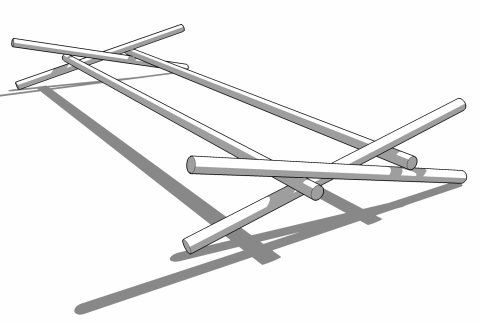
A good principle for storing pioneering poles is to keep them off the ground- this prevents them rotting (and keeps the snakes and scorpions out of them, depending on the climate). Normally in camp this means propping them up on scrap lengths of timber. I went out to Gilbanken this weekend where the Tshwane (Pretoria) Region were holding their annual Field Day and spotted this very elegant friction-locking pole store:

Related to this table , this store is simply two pairs of crossed 'legs' with the pole supports running between them. In the drawing above, the poles stored on the rack are transparent to show the actual structure; to see the rack without any poles at all click here.

(I have to admit that I am unable to give complete credit for this design: I wrote down "8th Pretoria St.Alban's" in my notebook, only to discover that there is an 8th Pretoria St.Andrew's troop and a 6th Pretoria St. Alban's troop. I'd appreciate it if someone can correct me here)

August 12, 2006

Bucket Raft from 1953 Scout annual

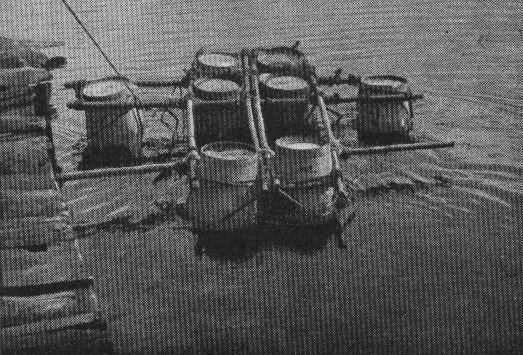
This photo and article come from the SCOUT magazine of July 31 1952. As far as I can tell, this is the first time this little raft is appearing on the Internet. For other raft articles, see the raft category. Here is the article as published:

Scouts of the 3rd Altrincham Troop have fun with a Bucket Raft.


Their Skipper- G.W. Sutcliffe- tells you how they made it.

This raft is simple to make from eight ordinary metal buckets, seven Scout staffs and a couple of dozen lashings. The illustration shows the method of construction and the cover picture shows the raft in use.

To launch the raft lift clear of the water and lower gently down into it. Water cannot fill the buckets because the air is imprisoned in them- the same principle as that used in a diving-bell.

If the raft is rocked-intentionally or otherwise-and some of the air is spilled and water gets into the buckets, the position can quickly and easily be restored by lifting the bucket clear of the water and lowering it down again gently.

The illustration shows the bare bones of the raft. A plank added to sit on makes for greater comfort.

TRY IT- IT WORKS